


What Is BC Game Crash?

The BC Crash game follows a simple risk-and-timing model. A round begins with a multiplier near 1.00x. The value increases while the round remains active and can stop at any moment.
A player who has an active bet can press Cash Out while the multiplier is still rising. The payout is based on the stake multiplied by the value at the moment the cash-out request succeeds. If the round crashes first, the active stake is lost.
Recent multiplier results can be viewed in the game interface, but they should be treated as historical information only. A sequence of low results does not mean that a high multiplier must follow, and several high rounds do not predict an early crash. The core decision is therefore not guessing the next result. It is deciding how much to stake and when to leave the active round.
How to Play Crash on BC Game
Playing BC Game Crash online requires only a stake and a cash-out decision. The main game interface includes the bet amount, current multiplier, Cash Out control, recent results, Manual and Auto modes, and configurable automation functions.
A normal round works as follows:
- Open Crash from the available game section.
- Enter the amount you want to stake.
- Submit the bet before the next round begins.
- Watch the multiplier increase from its starting value.
- Press Cash Out while the round is still active.
- Receive the calculated payout if the cash-out completes before the crash.
A bet submitted for the next round remains at risk once that round starts. If no successful Cash Out happens before the multiplier stops, the full stake placed on that round is lost.

Placing a Bet
The amount field controls how much money is committed to the next round. Players can enter a value manually and use available adjustment controls to change the stake before confirming it.
The interface also provides quick controls that can reduce or increase the current amount. These are useful when changing bet size between rounds, but they should not replace a fixed bankroll plan.
Before placing a bet:
- Amount should fit the session budget.
- Balance should be checked before increasing the stake.
- Stake should be confirmed before the next round starts.
- Previous losses should not determine the next bet size.
- Automation settings should be reviewed if Auto mode is active.
- Cash-out target should be chosen before the round where possible.
Once the round begins, the focus shifts from the amount to the rising multiplier and cash-out timing.
Watching the Multiplier

The multiplier starts low and increases while the round is running. A player who placed NGN 1,000 at 1.00x is still risking the full NGN 1,000 until a cash-out succeeds.
If the multiplier reaches 1.50x, the potential payout at that point is NGN 1,500. At 2.00x, it becomes NGN 2,000. Higher values produce larger potential payouts from the same stake.
The important word is potential. The multiplier displayed during the round does not become a payout automatically unless the player successfully cashes out.
It can also stop suddenly. There is no required minimum duration for a round that guarantees enough time to reach a preferred multiplier.
Using Cash Out
Cash Out ends the player’s participation in the current round and locks the payout at the multiplier reached when the action is successfully processed.
For Crash BC Game, this creates the central trade-off. Leaving earlier reduces exposure to a sudden crash, while waiting creates the possibility of a larger multiplier.
The payout includes the original stake. For example, a NGN 2,000 bet cashed out at 1.40x produces a NGN 2,800 payout, which means NGN 800 above the initial stake.
Cash Out must happen before the game crashes. If the crash occurs first, the bet does not receive a partial return simply because the multiplier had already risen. Players should therefore treat every active round as fully at risk until a cash-out has actually completed.
BC Game Crash Rules
The rules are short enough to understand before the first bet:
- Bet must be placed before the active round starts.
- Multiplier begins from its starting value and rises during the round.
- Crash point can occur before the player’s preferred target.
- Cash Out must complete before the crash to secure a payout.
- Payout equals the stake multiplied by the successful cash-out value.
- Uncashed stakes are lost when the round crashes.
The latest multipliers may be visible above the game area. They provide a record of previous outcomes rather than a forecast.
Manual and Auto options change how bets and cash-outs are managed, but they do not change the uncertainty of the crash point.
BC Game Crash Game Overview
| Feature | Description |
| Game Type | Real-time multiplier crash game |
| Bet | Amount committed before a round begins |
| Multiplier | Increasing value that determines potential payout |
| Cash Out | Ends the bet before the crash and locks the current payout |
| Manual Mode | Player controls betting and cash-out actions directly |
| Auto Mode | Automated betting functions can run according to configured settings |
| Auto Cash Out | Preselected multiplier can trigger an automatic cash-out attempt |
| Recent Results | Displays multiplier outcomes from previous rounds |
| Player Activity | Shows active player amounts and successful cash-outs |
| Automation Scripts | Auto interface includes configurable automated play options |
The BC Game Crash download does not need to be a separate game installation. Crash can be opened inside the supported BC Game mobile environment rather than installed as an independent Android or iPhone game.
Crash Multiplier Explained
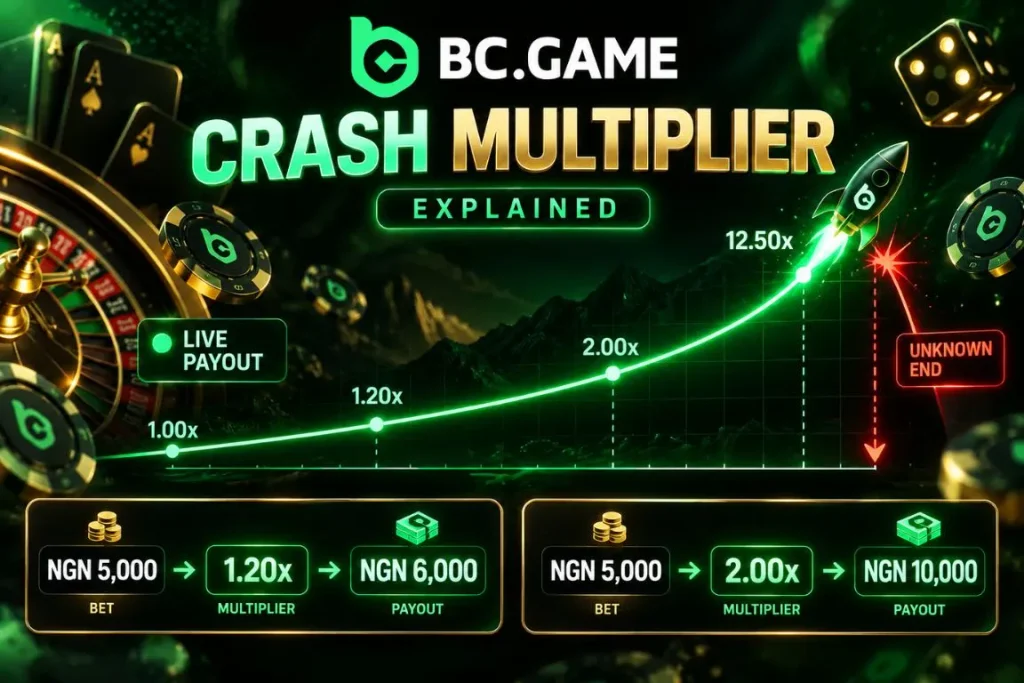
The multiplier determines the gross payout available while a bet is still active. At 1.20x, a NGN 5,000 bet has a potential payout of NGN 6,000. At 2.00x, the same stake would have a potential payout of NGN 10,000. The difference looks attractive, but reaching 2.00x requires remaining exposed for longer.
The multiplier cannot be treated like an interest rate that continues rising predictably. Each round has a crash point that the player does not know in advance.
A result of 1.20x on one round says nothing certain about whether the next will stop below 1.20x or continue beyond 10.00x. The correct way to read the multiplier is therefore as a live payout factor, not as a progress bar moving toward a known endpoint.
How Crash Winnings Are Calculated
Calculating your total return from a successful round involves a simple multiplication formula. You multiply your base bet by the multiplier value displayed at the exact millisecond you execute your cash out. For instance, if you stake 1,000 NGN and complete a cash out at a 2.50x coefficient, your total payout equals 2,500 NGN, resulting in a net profit of 1,500 NGN. However, every round outcome remains entirely independent and unpredictable in advance.
What Happens When the Game Crashes?
A crash ends the active round immediately. If a player already completed Cash Out, the payout stays locked at the multiplier achieved. If the stake was still active, it is lost.
This means a round that reaches 5.00x does not benefit someone who was waiting for 6.00x. The same logic applies at much lower values. A player targeting 1.20x can still lose if the round crashes at 1.10x.
There is no partial payout for getting close to a target. After the crash, the final multiplier is added to the recent result history and a new betting period begins for the next round. The game then repeats the same cycle without using the previous result as a guarantee for what comes next.
Auto Bet and Auto Cash Out

Automation is available for players who prefer predefined actions instead of manually repeating every step. Auto mode can execute configured betting logic once the player starts the automation. The interface also includes scripts such as Simple, Martingale, and Payout Martingale, together with an option to add a custom script.
These tools automate instructions. They do not improve the underlying probability of a round or make the next crash point predictable. Auto Cash Out is separate from choosing how bets are repeated. It lets the player set a multiplier that should trigger an automatic exit attempt when the round reaches that value.
Automation should always be reviewed before it runs because repeated bets can use a balance much faster than manual play.
How Auto Bet Works
Auto betting reduces the need to press Bet before every round. The player configures the available automated option and then starts it from the Auto interface.
The automation continues according to the selected rules until it is stopped or another configured condition interrupts it.
Before using Auto mode:
- Stake should be reviewed before pressing Run.
- Script should be understood before activation.
- Cash-out settings should match the intended risk level.
- Available balance should be checked carefully.
- Session budget should remain fixed.
- Automation should be stopped if the player is no longer monitoring it.
Options such as Martingale change stake behaviour after previous outcomes. They do not remove risk and can increase balance exposure rapidly.
How Auto Cash Out Works
Auto Cash Out allows a multiplier to be set before the round. If the game reaches that value while the bet remains active, the system attempts to cash out automatically.
A player might set 1.50x, for example. If the round reaches the target and the cash-out completes, the payout is calculated at that configured value.
The setting does not guarantee a successful round. The game can crash at 1.01x, 1.20x, or any other value below the selected target.
Auto Cash Out is therefore a discipline tool rather than a prediction tool. It can remove the temptation to keep waiting after the planned exit point, but it cannot stop the crash from occurring first.
Manual vs Auto Play in BC Game Crash
| Feature | Manual Play | Auto Play |
| Bet placement | Player submits each bet | Configured automation can repeat bets |
| Cash Out | Player presses Cash Out | Can use predefined automated behaviour |
| Auto Cash Out | Can be set before play | Can be incorporated into automated setup |
| Round control | Direct decision each round | Decisions follow configured rules |
| Reaction to previous result | Player decides manually | Script may adjust according to its logic |
| Monitoring | Required for every action | Still advisable while automation runs |
| Convenience | Better for occasional rounds | Better for repetitive configured play |
| Risk | Full stake remains at risk | Automation does not reduce underlying game risk |
Neither mode changes the uncertainty of the next crash point. The difference is how the player’s instructions are executed.
BC Game Crash Strategy

No strategy can guarantee the outcome of the next round. The practical purpose of a Crash strategy is to control exposure, decide when to cash out, and prevent a short session from consuming an uncontrolled part of the bankroll.
The most useful decisions are made before the multiplier starts moving.
A player can decide how much of the bankroll is allowed per round, what cash-out level fits that risk tolerance, and when the session ends.
Good control measures include:
- Stake should remain small relative to the available bankroll.
- Session budget should be set before the first round.
- Cash-out target should not change because of emotion.
- Bet size should not increase only to recover a previous loss.
- Auto play should have a clear stopping point.
- Remaining balance should be reviewed throughout the session.
These measures manage risk. They do not create an advantage over the game.
Low Multiplier Approach
A low-multiplier approach aims to cash out relatively early. For example, a player may choose a target around 1.20x or 1.50x rather than waiting for much larger values. Successful rounds produce smaller returns, but the stake remains exposed for less time.
This approach can make the session less volatile than repeatedly waiting for high multipliers, but it is not safe in the sense of guaranteeing a return.
Crash can occur below a low target. A 1.20x plan still loses if the round stops at 1.08x. Repeated small wins can also be erased by losses if the stake size or payout target is poorly managed. The main advantage is behavioural: the player uses a predefined exit instead of making a new emotional decision every second.
High Multiplier Approach
Waiting for a high multiplier increases the potential payout on a successful round but also keeps the full stake exposed for longer.
A player targeting 5.00x receives five times the stake if Cash Out succeeds at that point. The same player loses the full stake if the round stops anywhere below 5.00x.
High-target play can therefore produce more volatile results.
Several early crashes in sequence can deplete a bankroll quickly when the same large stake is repeatedly placed.
A high multiplier should never be interpreted as “due” because recent rounds were low. The opposite pattern is equally unreliable. Past multipliers do not establish a timetable for the next large result.
Bankroll Management
Bankroll control matters more than any attempt to find a winning multiplier pattern.
A practical structure is:
- Set the total amount available for the session.
- Choose a maximum stake per round.
- Select a cash-out target before betting.
- Set a loss limit that ends the session.
- Keep winnings separate from the urge to increase stakes.
- Stop when the planned time or money limit is reached.
Increasing stakes after a loss can rapidly increase total exposure. Martingale-style progression is particularly risky because each increase requires more balance to continue.
A budget should be treated as a hard limit rather than as the first amount before adding more money.
Can You Predict BC Game Crash?

No reliable method can tell a player the future crash point before a round. Recent results may show values such as 1.20x, 1.66x, 2.02x, or 5.06x, but a visible history does not create a dependable pattern for the next outcome.
The next round should therefore be treated independently from assumptions based on streaks. A sequence of low multipliers does not create a requirement for the game to “compensate” with a high result. Likewise, a recent high multiplier does not mean another one is less likely simply because it happened recently.
Players should base decisions on stake size and acceptable risk rather than trying to interpret historical colours, timing, player amounts, or recent cash-out behaviour as signals.
Crash Predictors and Signals
Tools claiming to reveal future multipliers should be treated with caution.
Common claims include:
- Predictor apps promise the next crash value.
- Signal groups publish supposed high-multiplier rounds.
- Bots claim to read hidden game patterns.
- Modified software claims access to future server results.
- Paid subscriptions promise guaranteed entry timing.
- Scripts claim they can remove the risk of losing rounds.
None of these claims changes the fundamental problem: a player does not legitimately know the future crash point.
Third-party predictor software can also create additional security risks if it requests login details, browser access, wallet information, or installation permissions.
A sensible approach is to ignore prediction claims and use only the game controls needed to place and manage a normal bet.
BC Game Crash on Mobile
Crash can be played from a smartphone through BC Game’s supported mobile access. The interface keeps the main controls within reach, including stake amount, Bet, multiplier display, Cash Out, recent round history, and Manual or Auto mode.
A separate BC Game Crash download is not necessary just to access this game. It runs inside the broader mobile platform, so the same account balance and profile can be used across supported devices.
On a smaller screen, the most important practical consideration is avoiding accidental taps. Check the amount before submitting a bet and make sure the Cash Out area is visible while the round is active.
A stable connection also matters because Crash is a real-time game. A delayed screen or interrupted network can interfere with the player’s ability to react during a live round.
BC Game Crash Features
| Feature | How It Works | What to Know |
| Multiplier | Rises during the active round | Stops when the crash occurs |
| Bet | Sets the money at risk | Must be submitted before the round |
| Cash Out | Locks payout at the current successful multiplier | Must complete before the crash |
| Auto Cash Out | Uses a preset multiplier | Target can still be missed if crash occurs first |
| Manual Mode | Player controls each action | Requires active attention |
| Auto Mode | Runs configured automated actions | Does not predict results |
| Recent History | Shows completed multiplier results | Past results do not guarantee future outcomes |
| Player Panel | Displays active amounts and cash-outs | Other players’ behaviour does not predict the round |
| Automation Scripts | Provides predefined or configurable logic | Progressive systems can increase risk quickly |
Is BC Game Crash Fair?
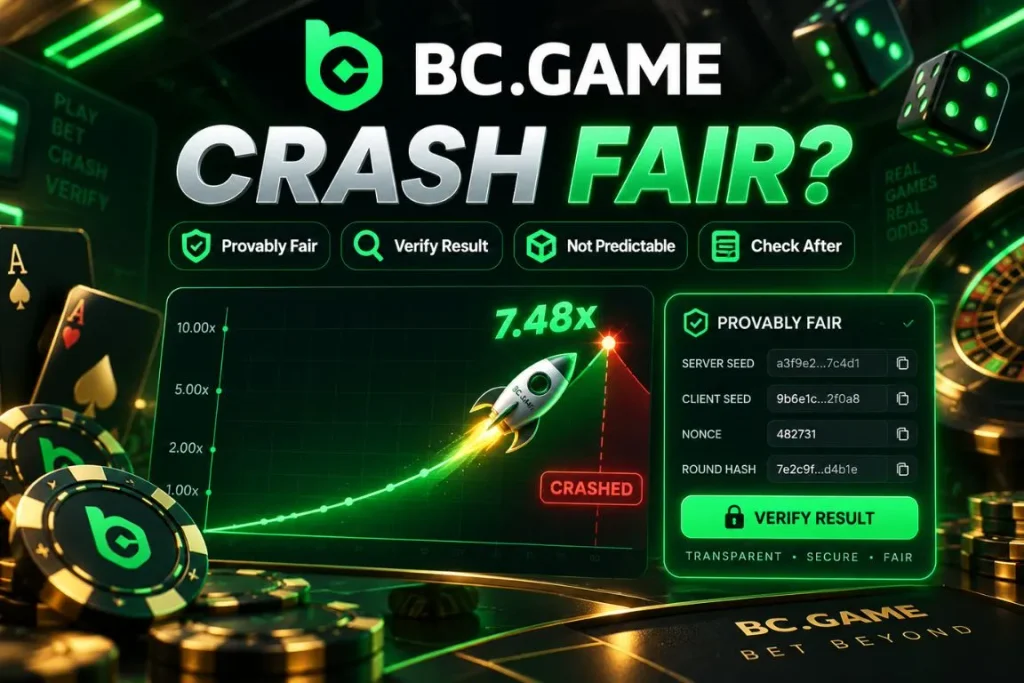
Crash is designed around a Provably Fair system that allows round outcomes to be checked using cryptographic information rather than relying only on the visual animation.
This distinction matters. Provably Fair does not mean that players can know the crash point before placing a bet. It means the result can be verified against the data used to generate the round.
The system is intended to make retrospective checking possible while keeping the future result unavailable before play.
A fair verification mechanism also does not mean every player has an equal chance of cashing out at a chosen multiplier. Individual outcomes still depend on the generated crash point and the player’s timing. The presence of verification therefore addresses result integrity, not profitability.
Crash is designed around a Provably Fair system that allows round outcomes to be checked using cryptographic information rather than relying only on the visual animation.
This distinction matters. Provably Fair does not mean that players can know the crash point before placing a bet. It means the result can be verified against the data used to generate the round.
The system is intended to make retrospective checking possible while keeping the future result unavailable before play.
A fair verification mechanism also does not mean every player has an equal chance of cashing out at a chosen multiplier. Individual outcomes still depend on the generated crash point and the player’s timing. The presence of verification therefore addresses result integrity, not profitability.
How Provably Fair Works
Provably Fair uses cryptographic inputs connected to a game result. These values allow a completed round to be checked and compared with the result that was displayed.
In practical terms:
- Game creates the cryptographic data used for the round.
- Player participates without seeing the future crash result.
- Round ends at its generated multiplier.
- Relevant verification information becomes available.
- Result can be checked through the Provably Fair function.
- Verification confirms whether the displayed outcome matches the generated data.
The process is intended for verification after the result, not prediction beforehand.
A user does not gain advance knowledge of whether the next round will stop at 1.05x or continue to a much higher multiplier.
Responsible Crash Gaming
Crash moves quickly and makes repeated betting easy, which can make a short session consume more money than expected.
The game should be treated as paid entertainment with a possibility of losing the full stake on any individual round, not as a regular source of income.
Useful controls include:
- Budget should be decided before opening the game.
- Bet size should remain consistent with that budget.
- Time limit should be set for the session.
- Losses should not be chased with larger stakes.
- Automation should not run unattended.
- Session should end when the preset limit is reached.
Fast rounds can encourage players to make another bet immediately after a loss. That speed is exactly why fixed limits matter. A break is more useful than increasing the stake when frustration begins to influence decisions.